Placement guide
Porta Potty Placement and Access: Where It Goes and What the Driver Needs
The checklist our drivers use, the mistakes that cause return trips, and Butler's rule for units on streets and sidewalks.
Calls answered in person Mon–Sat, 7 AM–7 PM
Where should a porta potty be placed?
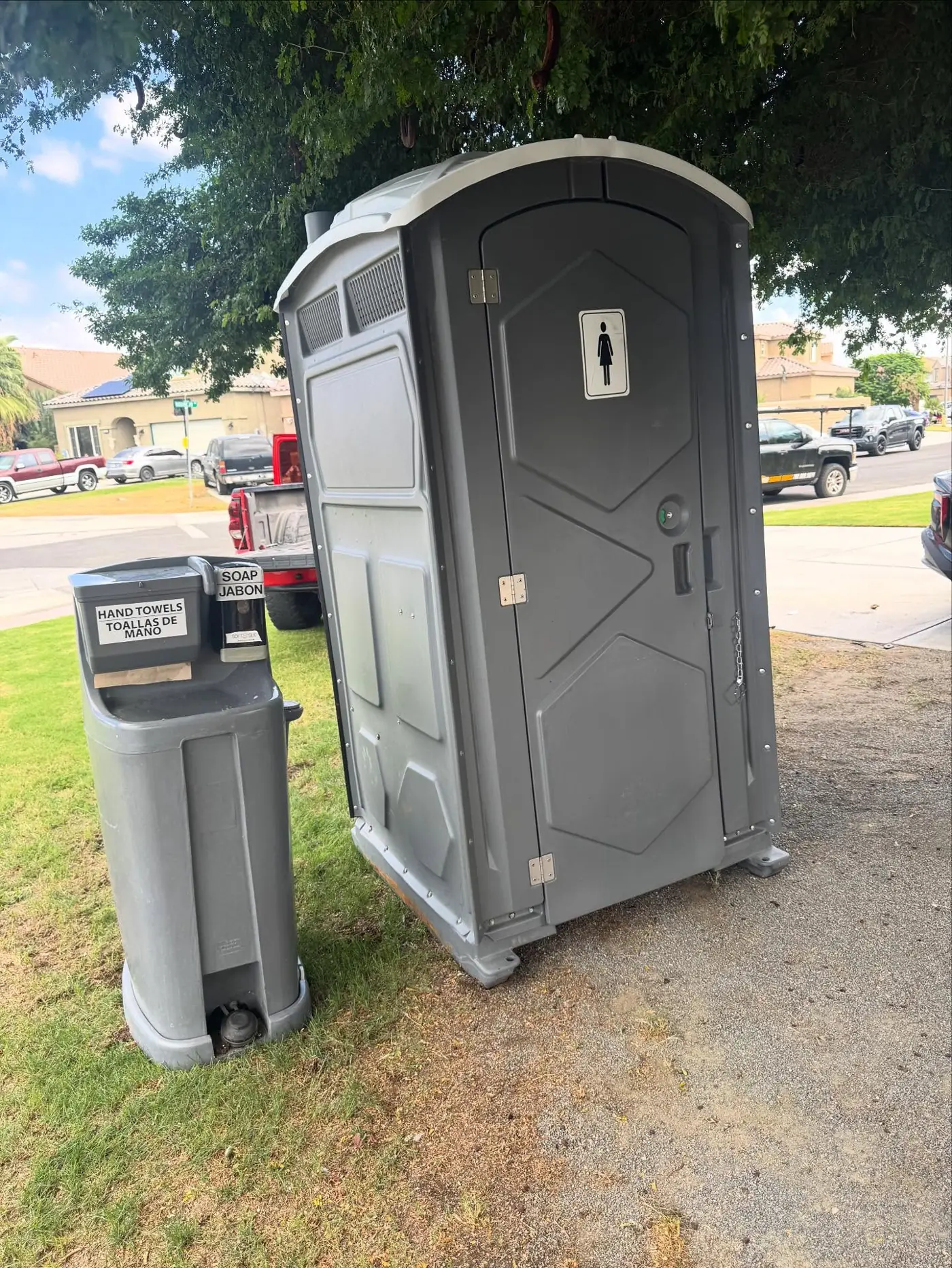
Place a porta potty on firm, level ground within 25 feet of where a truck can park, with a straight path at least 48 inches wide, away from food and seating, downwind of the gathering, not on a septic drain field, not under power lines below 14 feet, and not where a plow, mower or delivery truck will hit it. Driveway edges, gravel pads and compacted lawn are the usual spots in Butler.
- Ground: level within 5%, firm enough to walk on without sinking. Soft spring lawns and fresh fill are the usual problems.
- Truck access: our delivery and service trucks need a 10-foot-wide, 14-foot-tall path to within 25 feet of the unit.
- Gates: 48 inches for standard units, 52 for deluxe and flushable, 66 for accessible. The driver uses a hand truck; the path must be straight.
- Distance from the party: 50–75 feet from tents and food, with a lit path for evening events.
- Privacy: door facing away from the street and from windows.
- Drain fields and wells: keep the unit and the truck off the septic field and 50 feet from a wellhead.
- Wind: open ridges and fields in Butler County get staked and strapped.
What does the driver need to know before delivery?
The driver needs the exact spot (a painted X or a photo), the gate code or an unlocked gate, whether dogs are out, where the truck can park, and a phone number for someone on site. With those five things, most Butler deliveries take 15 minutes and you do not need to be there. Without them, the driver calls and, if no one answers, places the unit at the nearest safe spot.
- Mark the spot. Spray paint, a stake with tape, or a texted photo with an arrow.
- Open the way. Gate codes, locked chains, cars moved, dogs inside.
- Name a contact. A phone number the driver can call from the street.
- Say what is in the ground. Septic field, sprinkler heads, shallow lines, new sod.
- Say what is overhead. Low wires, tree limbs under 14 feet on the truck path.
Which placement mistakes cause a return trip?
The five placement problems that send a truck back are a locked gate with no code, a spot the truck cannot reach within 25 feet, a slope the unit cannot be leveled on, a lawn too soft to roll a hand truck across, and a unit boxed in by materials, cars or snow on the service day. Each is a return trip at the $75 delivery rate, which a phone call the day before avoids.
| Site type | Best spot | Avoid |
|---|---|---|
| Home party | Driveway edge or side yard on pavers | Behind the house with a 36-inch gate; the drain field |
| New home build | Lot edge near the drive, moved to the garage apron later | Inside the footprint; under the crane swing |
| Farm or barn wedding | Gravel pad 50–75 ft from the barn, lit path | The pasture after rain; under the tree line |
| Park shelter | Paved lot edge nearest the shelter | Grass inside the shelter area (mowers) |
| Jobsite in winter | Plowed pad by the site entrance | Anywhere the plow pushes snow |
| Street or sidewalk (City of Butler) | Only with a §232-6 obstruction permit | Blocking a hydrant, crosswalk or ADA ramp |
Can a porta potty go on the street in Butler?
On a City of Butler street, alley or sidewalk, a porta potty is an obstruction under City Code §232-6 and requires a permit from the Office of Business and Community Development, 140 W. North Street, before placement. Business-district barricades fall under §232-23 and are limited to 30 days. On private driveways and lots, no permit is required. Townships around Butler generally follow the same pattern: private property free, public right-of-way by permit.
Sources: City of Butler Code Ch. 232 Streets and Sidewalks; City Building, 140 W. North St. Checked October 2026. Confirm with the municipality before booking a street placement; we are not a permit service.
How do you keep a unit from tipping or walking?
We stake and ratchet-strap every unit on open ground, rooftops and windy sites, bank rows back-to-back at festivals, and can padlock doors overnight with a padlock we supply. Lighting is the best deterrent to vandalism; a $25 solar light on each unit and a path light cut overnight problems to almost zero at public parks.
Winter placement, brine and plowed access are covered in the winter rental guide. Unit widths and gate needs for each model are on the comparison page.
Placement questions
Can it go in my backyard if the only way is through a 36-inch gate?
Not a standard unit, which is 43.5 inches wide. The driver will set it at the front or side of the house where the path is 48 inches. If a backyard spot matters, a section of fence panel can be removed for 10 minutes on delivery day.
Will the unit damage my lawn?
A standard unit on its skids leaves two shallow marks that disappear after a mow. The hand truck can mark soft, wet lawn; on those days we lay a 4 × 8 mat for $35 or use the driveway edge.
Do I have to be home for delivery?
No, if the spot is marked, the gate is open and the driver has a phone number. Most Butler deliveries happen with nobody home.
How far from the house should it go for a party?
Fifty to seventy-five feet from where people sit and eat, close enough to walk without a flashlight. For evening parties add a solar light or place it where a porch light reaches.
Can you put it on the septic drain field if that is the flattest spot?
No. The unit itself is light, but the delivery and service trucks are not, and a truck on a drain field crushes laterals. Tell us where the field is and we will pick the next-best spot.
Can I move the unit myself after delivery?
Please call us instead. A unit with liquid in the tank weighs 400+ pounds and tips easily. We move units for the delivery charge, or free during a scheduled service if the new spot is within 25 feet.
Tell us your site and we will confirm the spot
Calls answered in person Mon–Sat, 7 AM–7 PM